
Last year, my friend Rahul went to a busy shop in Mumbai to buy an engagement ring. He was confused by the bright lights and pushy sales. They promised big discounts, but he later found out he paid too much for a ring without the right papers.
Don’t let the glitter blind your judgment. Many people in India get caught up in thinking only about the discounts. But, learning how to choose diamond jewellery means looking at more than just the price.
Smart shopping means knowing the Four Cs, the type of metal, and checking the papers. By choosing quality over sales, you make sure your money is well spent. This guide will help you shop wisely, so you never pay too much.
Key Takeaways
- Focus on the Four Cs—cut, color, clarity, and carat—to determine real value.
- Always demand official certification from reputable labs for every purchase.
- Look beyond flashy discounts and analyze the total final price.
- Understand the importance of setting durability and metal quality.
- Prioritize seller transparency to avoid hidden costs and markups.
How to choose diamond jewellery without overpaying
Finding the perfect diamond jewellery starts before you go shopping. Many people focus too much on the diamond’s sparkle. They forget about the practicality of the purchase.
By thinking about what you need, you can find the right piece. This way, you get something that fits your life and budget.
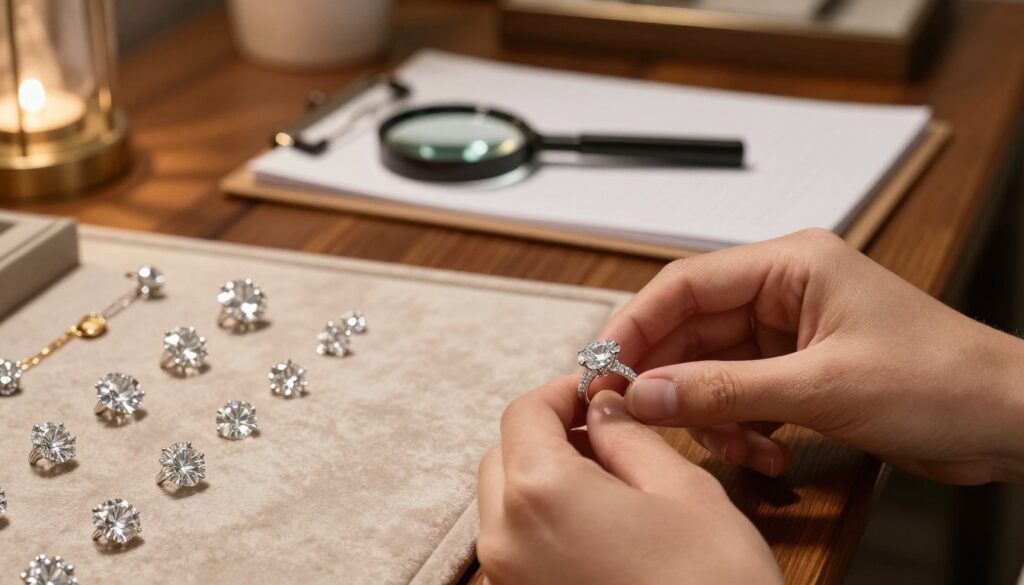
Step 1: Define the jewellery’s purpose before you shop
Separate engagement, wedding, gifting, and everyday-wear priorities
Every piece of jewellery has its own role. An engagement ring needs to be strong because you wear it all the time. But a gift might focus on its look rather than how durable it is.
Think about how you live when choosing jewellery. For daily wear, pick something simple that won’t catch on clothes. This diamond jewellery buying guide helps you avoid unnecessary costs.
Set a complete budget for the diamond, setting, taxes, and services
Don’t just look at the diamond’s price. You need to think about the whole cost. This includes the setting, taxes, and any future expenses like resizing.
| Jewellery Type | Primary Focus | Budget Priority | Maintenance Need |
|---|---|---|---|
| Engagement Ring | Durability | High (Center Stone) | Frequent Cleaning |
| Wedding Band | Comfort | Medium (Metal) | Low |
| Occasional Gift | Design/Style | Variable | Minimal |
| Everyday Wear | Security | Balanced | Regular Inspection |
Planning for extra costs helps you manage your money better. Remember, the total package is more important than the diamond’s price. Being ready helps you stay within your budget and get a beautiful piece.
Step 2: Understand the Four Cs before comparing prices
Many buyers feel overwhelmed by technical terms. But the Four Cs give a clear roadmap for your purchase. These tips for selecting diamond jewellery help you focus on what truly matters. By learning this framework, you gain the confidence to make a smart financial decision.
Use cut, color, clarity, and carat as a value framework
The Four Cs—cut, color, clarity, and carat—are the universal language of the diamond industry. Each factor plays a specific role in determining the rarity and price of a stone. Cut dictates the sparkle, color refers to the lack of tint, clarity measures internal flaws, and carat defines the weight.
Distinguish a diamond’s quality grade from its visual appearance
It is vital to remember that a laboratory report is not the same as a mirror. A grading certificate provides objective data about the stone’s physical properties under magnification. However, your eyes perceive the diamond based on how it interacts with light in your specific environment.
Why a higher grade is not always the best purchase
You might be tempted to buy the highest grade available, but this often leads to unnecessary spending. In many cases, a diamond with a slightly lower grade will look identical to the naked eye. Prioritizing visual beauty over a perfect report can save you a significant amount of money without sacrificing style.
How proportions and grading standards affect comparisons
When you use these tips for selecting diamond jewellery, always look at the proportions listed on the certificate. Two diamonds with the same carat weight can look very different if one is cut too deep or too shallow. Always compare stones using the same grading standards to ensure you are getting a fair deal.
Step 3: Prioritize cut for visible sparkle
Many buyers focus on size, but the cut is what actually brings your diamond jewellery to life. When you follow smart diamond jewellery selection tips, you quickly realize that the cut determines how light interacts with the stone. A well-cut diamond reflects light back to your eyes, creating that signature brilliance you desire.
Look for brightness, fire, scintillation, and balanced proportions
The beauty of a diamond relies on three main light effects. Brightness refers to the white light reflected from the stone, while fire is the dispersion of light into spectral colors. Scintillation is the sparkle you see when the diamond or your hand moves.
Balanced proportions ensure these elements work in harmony. If the proportions are off, light leaks out of the bottom or sides, leaving the stone looking dull. Always prioritize a high-quality cut to ensure your investment truly glows.
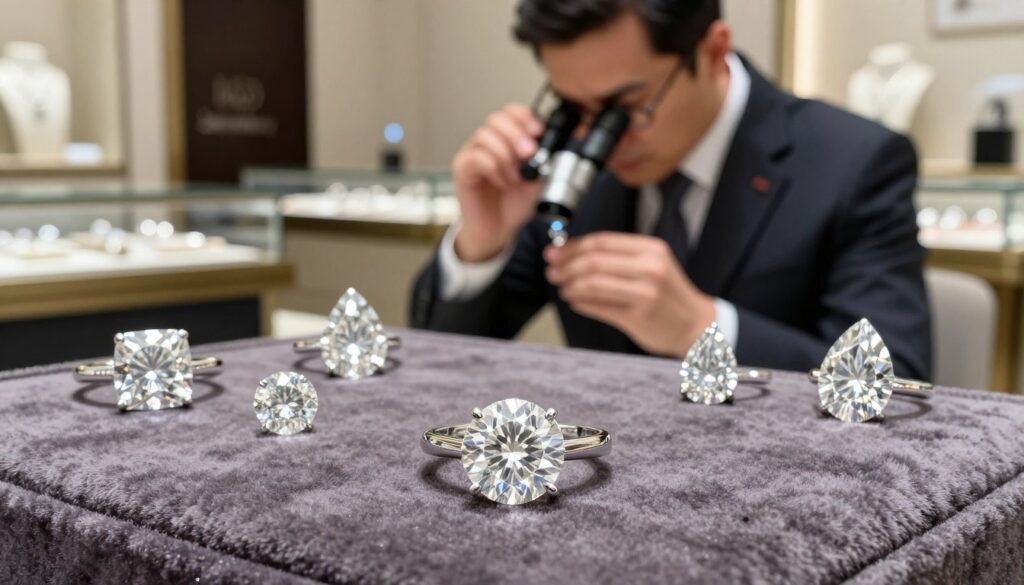
Compare excellent and very good cut grades in person
While grading reports are helpful, seeing the stones side-by-side is essential. An “Excellent” grade is the gold standard, but a “Very Good” cut can often offer similar visual appeal at a lower price point. You should view them under different lighting conditions to see which one captures your eye.
Check for dark areas, dull patches, and uneven reflections
Look closely at the center of the stone for any dark or “dead” spots. These areas indicate that the light is not being reflected properly. A high-quality cut should appear vibrant and lively from every angle without any obvious dull patches.
Assess symmetry, polish, fluorescence, and table proportions
Symmetry ensures that the facets align perfectly, which is vital for light return. Polish refers to the smoothness of the diamond’s surface, while fluorescence can sometimes make a diamond appear milky in direct sunlight. Check the table percentage, as a table that is too large or too small can negatively impact the overall brilliance.
Choose practical shapes for your budget
The shape of your diamond significantly influences both the price and the perceived size. Some shapes, like the round brilliant, are optimized for maximum sparkle but often carry a premium price tag. Other shapes can offer a larger surface area for the same carat weight, helping you maximize your budget.
Compare round, oval, princess, pear, cushion, and emerald cuts
- Round: The classic choice for maximum brilliance and fire.
- Oval: Offers a larger appearance than a round diamond of the same weight.
- Princess: A modern, square shape that provides excellent sparkle.
- Pear: A unique teardrop shape that elongates the finger.
- Cushion: Known for its soft, romantic, and vintage appeal.
- Emerald: Features a step-cut design that emphasizes clarity over intense sparkle.
By understanding these shapes, you can refine your diamond jewellery selection tips to find a piece that fits your personal style and financial goals perfectly.
Step 4: Choose a diamond color that looks bright in its setting
Knowing how color works with your metal setting can save you money. Following the best diamond jewellery selection practices helps you avoid paying for things you can’t see once the stone is set.
Understand the D-to-Z color scale
The diamond industry uses the D-to-Z scale to measure colorlessness. A D grade means the diamond is completely colorless. Grades closer to Z show more yellow or brown.
Remember, these grades talk about the absence of color, not the stone’s beauty. A diamond with a lower grade can look just as good as a top-grade one in a normal setting.
Match color tolerance to the metal you select
Your metal choice affects how the diamond’s color looks. White metals like platinum or white gold reflect cool tones, making warmth more noticeable.
Warm metals, on the other hand, hide these tints well. Choosing a color grade that matches your metal can save money without losing beauty.
When near-colorless grades offer better value than colorless grades
Many think only D, E, or F grades are good for quality pieces. But, near-colorless grades from G to J offer exceptional value for less money.
To the eye, these stones appear perfectly white in a ring or pendant. Picking a near-colorless diamond is a smart choice for a bigger stone at a lower price.
Why yellow and rose gold can disguise slight warmth
Yellow and rose gold settings hide the natural warmth in lower color grades. These metals’ hues complement stones with a slight yellow tint.
This lets you choose a diamond with a lower color grade, like K or L, for a beautiful look. The metal frames the diamond, making it appear brighter and more balanced.
| Color Grade Range | Best Metal Pairing | Value Perception |
|---|---|---|
| D – F (Colorless) | Platinum / White Gold | Premium Investment |
| G – J (Near-Colorless) | White, Yellow, or Rose Gold | High Value Balance |
| K – M (Faint Color) | Yellow or Rose Gold | Budget-Friendly Choice |
Using these best diamond jewellery selection practices helps you make a smart choice. Always think about how the diamond will look in your setting before buying.
Step 5: Evaluate clarity by eye instead of paying for an unnecessary grade
Clarity is often misunderstood when picking the right diamond jewellery. Many think they need a “Flawless” or “Internally Flawless” stone. But, spending on a grade you can’t see is common.
Learn what clarity inclusions and blemishes mean
Every natural diamond has its own story. Inclusions are tiny things inside the stone. Blemishes are marks on the surface from cutting and polishing.
These marks are like birthmarks for your diamond. They’re noted on a report but might not affect its beauty. You want a stone where these marks aren’t seen by the naked eye.
Check whether the diamond is eye-clean at normal viewing distance
The term “eye-clean” is key when looking for value. A diamond is eye-clean if you can’t see inclusions at six to twelve inches. If it looks clear and bright, the exact grade doesn’t matter as much.
Compare SI1, VS2, VS1, and VVS grades realistically
Think of these grades as a range, not a strict order. An SI1 (Slightly Included) diamond can look as good as a VVS (Very, Very Slightly Included) one without a magnifying glass. Choosing a lower clarity grade can save you money for a bigger stone or better cut.
Pay special attention to inclusions near the center or edges
Where an inclusion is located matters a lot. Ones in the center can be seen and might take away from sparkle. But, those near the edges might be hidden by the prongs of your setting, making them invisible in jewellery.
Always look at the stone from different angles. This ensures no dark spots or cloudy areas are there. By focusing on how it looks, you’re choosing the right diamond jewellery wisely and saving money.
Step 6: Select carat weight according to appearance and comfort
Finding the right size and comfort is key in expert advice on diamond jewellery selection. Many think bigger means more carats. But carat is about weight, not size.
Compare millimeter measurements, not carat numbers alone
To see how a diamond looks, check its millimeter size. Two diamonds with the same carat can look different. A well-cut diamond looks bigger than a heavy one.
Balance diamond size against cut quality and setting security
A big stone is nice, but not at the cost of cut quality. A bad cut diamond looks dull, no matter its size. Also, a big stone needs a secure setting to avoid damage.
Recognize popular weight thresholds that can increase prices
Prices jump at certain weights like 0.50, 1.00, or 2.00 carats. Choosing a diamond just below these weights can save money. For example, a 0.90-carat diamond looks almost the same as a 1.00-carat but costs less.
Consider spread, finger coverage, and everyday practicality
Think about these when picking your piece for long-term happiness:
- Finger Coverage: Pick a shape that covers more of your finger.
- Practicality: Make sure the setting doesn’t get in the way of your day.
- Proportions: A balanced stone is more durable and sparkly.
By paying attention to these, you can get expert advice on diamond jewellery selection. This way, you’ll find a piece that looks great and feels good for years.
Step 7: Compare natural and lab-grown diamonds carefully
It’s key to know the differences between natural and lab-grown diamonds. This helps you make a smart choice. Both have their own benefits, depending on what you want.
Understand the differences in origin, pricing, and resale expectations
Natural diamonds form deep in the earth over billions of years. They are rare and precious. Lab-grown diamonds, on the other hand, are made in labs that mimic earth’s pressure.
Even though they’re the same in many ways, their prices and values are different. Natural diamonds are often seen as more valuable over time. Lab-grown diamonds are cheaper because they can be made endlessly.
Choose natural diamond jewellery when rarity and tradition matter most
Natural diamonds are great for family heirlooms or symbols of tradition. They are rare and carry a special status. This makes them valuable to many collectors.
Choosing natural diamonds connects you to India’s rich diamond history. These stones are a solid investment in heritage.
Consider lab-grown diamond jewellery when size and budget are priorities
Lab-grown diamonds let you get more for your money. You can get a bigger stone or better quality for less than a natural diamond. This is perfect for those who want big, stylish pieces.
Lab-grown diamonds are great for fashion-forward designs. With smart diamond jewellery buying tips, you can get a beautiful piece that fits your budget.
Confirm that the certificate clearly identifies the diamond type
Always check the diamond’s origin with the grading report. A good seller will show you this report. It will say if the diamond is natural or lab-grown.
Don’t skip this step. It’s important for being clear and for insurance. Make sure the certificate is from a trusted lab.
Avoid treating lab-grown diamonds as automatically better value without comparison
Don’t think lab-grown diamonds are always better. The value depends on the quality, setting, and craftsmanship. Compare both before choosing.
A well-made piece of diamond jewellery should be judged on its own. Don’t just look at where it came from.
| Feature | Natural Diamond | Lab-Grown Diamond |
|---|---|---|
| Origin | Geological formation | Controlled laboratory |
| Rarity | High (Finite supply) | Low (Unlimited supply) |
| Resale Value | Historically stable | Generally lower |
| Budget Impact | Premium pricing | Cost-effective |
Step 8: Choose the setting and metal without hiding value problems
When you buy diamond jewellery, the metal and setting matter a lot. They change how the piece looks and its value. Knowing the right tips for selecting diamond jewellery keeps your investment safe and stylish for years.
Compare gold purity, platinum, and durability for Indian wear
In India, picking a metal is about tradition and everyday use. Think about how often you’ll wear it. Some metals last longer than others.
Understand 18-karat, 14-karat, 22-karat gold, and platinum options
Gold’s purity is shown in karats. It tells you how much gold is in the mix. 22-karat gold is very valuable but too soft for detailed settings. 18-karat gold is strong and fancy, great for diamond pieces.
| Metal Type | Durability | Best Use |
|---|---|---|
| 14-Karat Gold | High | Daily wear, active lifestyles |
| 18-Karat Gold | Medium | Engagement rings, special occasions |
| 22-Karat Gold | Low | Traditional heavy jewellery |
| Platinum | Very High | Secure diamond settings |
Check BIS hallmarking on eligible gold jewellery
Always check the BIS hallmark on gold jewellery. It shows the metal’s purity. This mark ensures you’re not overpaying for lower-quality metals. Always check this, it’s smart shopping.
Match the setting to the diamond’s shape and security needs
The setting does more than hold the stone. It shows the piece’s personality. Picking the right setting is key to tips for selecting diamond jewellery that lasts.
“A well-crafted setting is the silent guardian of your diamond, ensuring that its brilliance is showcased while its integrity remains protected.”
Compare prong, bezel, halo, pavé, and solitaire settings
Prong settings let lots of light in, while bezel settings protect the stone. Solitaire settings are timeless. Halo and pavé settings add sparkle with smaller diamonds.
Watch for settings that make a smaller center diamond appear larger
Halo settings make a diamond look bigger by adding smaller stones around it. This trick makes the jewellery look bigger without a big diamond. Strategic design choices help you save money while looking great.
Step 9: Match the design to your lifestyle and maintenance routine
Think about how your daily life will affect your diamond jewellery. Using diamond jewellery selection tips helps avoid problems later. This way, your jewellery stays beautiful forever.
Choose comfortable proportions for daily wear
Your jewellery should feel like a part of you. If you’re always on the move, pick smaller pieces. They won’t get caught on clothes or feel too heavy.
Go for low-profile designs that fit close to your skin. They’re comfy for everyday and less likely to get damaged.
Assess snagging, cleaning, resizing, and repair requirements
Every design has its own care needs. Some settings might catch on fabrics like silk or chiffon, common in Indian clothes.
Make sure the setting is easy to clean at home. Also, check if it can be resized or fixed by a local jeweller without harming the diamond setting.
“The best piece of jewellery is one that you can wear with confidence, knowing it is built to withstand the rhythm of your daily life.”
Select secure earrings, necklaces, bracelets, and rings for active routines
If you travel or work out a lot, choose secure jewellery. Pick screw-back earrings or secure clasps for necklaces. They stay put when you move.
For rings, look for bezel or tension settings. They keep the diamond safe and are better for busy hands than high-prong settings.
Consider skin sensitivity and metal-alloy preferences
How your skin reacts to metals is key. Some people get rashes from nickel in cheap gold.
| Metal Type | Durability | Skin Sensitivity | Maintenance |
|---|---|---|---|
| 18K Yellow Gold | Moderate | Low Risk | Regular Polishing |
| Platinum | High | Hypoallergenic | Low |
| Rose Gold | High | Moderate | Moderate |
Choose pure metals or platinum if your skin is sensitive. The right metal keeps your jewellery a joy, not a problem.
Step 10: Verify certification, grading, and product authenticity
When you buy fine jewellery, the paperwork is key. It’s as important as the diamond’s sparkle. Following diamond jewellery shopping tips helps you get what you paid for. It keeps your money safe from fraud or wrong information.
Request an independent diamond grading report
An independent grading report is a neutral assessment of your stone’s quality. It breaks down the Four Cs. This helps you compare prices between different shops.
Compare reports from GIA, IGI, and HRD Antwerp
Lab reports from GIA, IGI, and HRD Antwerp are trusted worldwide. Choose stones with these reports for the most reliable info.
Match the report number, laser inscription, and physical diamond
After getting the report, check if it matches your diamond. Look at the laser inscription on the diamond’s girdle. Make sure it matches the report number on the document.
Check the seller’s invoice and product disclosures
Your invoice is your legal shield. It should list all details from your diamond jewellery shopping tips research. This ensures everything is clear.
Confirm natural or lab-grown origin, treatments, dimensions, and weight
Know if the diamond is natural or lab-grown. This affects its value. Your invoice should list treatments, carat weight, and dimensions clearly.
Review India-specific GST, hallmark, and warranty documentation
In India, check your invoice for a valid GST identification number. Also, look for the BIS hallmark on gold settings. Keep your warranty card for future services.
Step 11: Compare the full price instead of the advertised discount
To buy fine jewellery well, look beyond the price shown. This diamond jewellery buying guide shows you the real cost. It breaks down the price into main parts.
Break the quotation into diamond, metal, making, taxes, and add-ons
A clear invoice lists the diamond cost, gold or platinum details, and making charges. Don’t accept a single price. Ask for a detailed breakdown to pay fairly for materials and work.
Compare like-for-like diamonds using the same Four Cs and certificate standards
When comparing prices, make sure they’re the same. A diamond with lower clarity or different certification costs less. Always compare diamonds with the same specs and from the same lab.
Calculate the effect of making charges and GST in India
In India, making charges change with design complexity. GST is added to the total, including labor costs. Calculate these percentages early to avoid surprises at checkout.
Check whether discounts apply to the diamond, setting, or total bill
Retailers offer big discounts to draw in customers. But these might only apply to parts of the piece. Know if the discount is on the diamond, metal, or total. This is key to keeping your budget.
Evaluate buyback, exchange, upgrade, and resale terms separately
The value of your purchase depends on future policies. See buyback, exchange, and upgrade terms as separate deals. Review these policies in writing before buying to keep your investment flexible.
Step 12: Shop with a seller who provides transparent information
Being open is key to a good diamond buying experience. When you buy luxury items, check your seller as much as the diamond. Your comfort matters, whether you’re at a classic store or online.
Compare established jewellers, specialist retailers, and online stores
India has many places to buy diamonds, from old family shops to new online stores. Each has its own good points.
- Established Jewellers: They offer a personal touch and are known for being trustworthy.
- Specialist Retailers: They know a lot about diamonds and have special collections.
- Online Stores: They are easy to use and often cheaper, but you need to check them carefully.
Ask precise questions before making a payment
Don’t be shy about asking questions before you pay. A good seller will answer all your questions clearly.
Request videos, magnified images, measurements, and certificate copies
Seeing the diamond is important. Ask for videos and clear pictures to check it out. Seeing the diamond up close helps spot tiny flaws.
Ask about sourcing, return periods, repairs, resizing, and delivery insurance
Knowing what happens after you buy is important. Make sure you get answers about:
| Service | Key Question to Ask |
|---|---|
| Sourcing | Is the diamond ethically mined or lab-grown? |
| Returns | What is the window for a full refund? |
| Maintenance | Are resizing and repairs covered under warranty? |
Check reviews and business credentials without relying on testimonials alone
Customer feedback is helpful, but don’t just rely on it. Look for official business info too.
“Trust is built when a seller provides clear, written policies that protect the buyer’s interests long after the sale is complete.”
Using these best diamond jewellery selection practices helps protect your money. Always choose sellers who are honest and professional.
Step 13: Inspect the diamond jewellery before accepting it
Looking at your jewellery in person is very important. Showroom lights make stones look great but hide small flaws. A final check makes sure your purchase is perfect.
Use neutral lighting and multiple viewing angles
Ask to see your piece in natural light. Spotlights can hide flaws that show up in everyday life. Look at it from different sides to see how light affects it.
Check the diamond, prongs, mount, clasp, and finish for defects
Check your jewellery carefully to make sure it’s good. Feel the prongs to see if they’re smooth. Look at the mount for any problems.
Compare the delivered piece with the approved certificate and invoice
Make sure the diamond’s laser mark matches the report. Check the carat weight, color, and clarity on your invoice against the report. This gives you peace of mind.
Test fit, comfort, symmetry, and closure security
Check if a ring fits well and sits straight. Test a necklace or bracelet’s clasp to make sure it’s secure. Make sure the design is balanced and the diamond is centered.
Document the purchase for insurance and future servicing
Keep all your purchase documents in a safe place. This includes the invoice, grading report, and any warranties. It helps with insurance and future repairs.
| Inspection Area | What to Look For | Action Required |
|---|---|---|
| Diamond Surface | Chips, scratches, or inclusions | Verify against report |
| Prongs & Mount | Tightness and alignment | Ensure no snagging |
| Clasp & Closure | Security and ease of use | Test multiple times |
| Documentation | Matching serial numbers | Store in a safe place |
By following these steps, you can buy diamond jewellery with confidence. A careful check protects your investment and keeps your piece special for years.
Step 14: Avoid common overpayment traps and negotiate responsibly
You can get a beautiful piece of jewelry without falling for tricks. Follow these simple steps. Expert advice on diamond jewelry selection helps you know real value from high prices. Stay alert to keep your purchase a joy, not a regret.
Recognize red flags in diamond jewellery advertising
Be cautious with extreme discounts, vague certificates, and pressure tactics
Watch out for stores with huge discounts that seem too good to be true. They might start with high prices. If someone pushes you to buy fast, stop and think.
Always ask for a real, independent grading report. Don’t settle for a vague certificate that doesn’t show real data.
Do not pay extra for meaningless labels such as “premium” without evidence
Terms like “premium” or “exclusive” might mean higher prices without better quality. Ask for proof or grading reports to support these claims. If there’s no proof, you’re paying for a label, not the diamond.
Negotiate the total package rather than chasing a single discount
Compare making charges, complimentary services, and warranty coverage
When looking for diamond jewelry shopping tips, remember the price includes more than the stone. Check the making charges, which can differ a lot. Look for extras like free cleaning or long-term warranty.
Get every promised benefit in writing before paying an advance
Don’t trust just verbal promises about discounts or services. Make sure all benefits, like buyback terms or free resizing, are written down. Having these details in writing before you pay is key for peace of mind.
“Price is what you pay. Value is what you get.”
Protect yourself with clear payment and return conditions
Use secure payment methods and retain the invoice and certificate
Use safe payment methods like bank transfers or credit cards. Keep your original invoice and diamond certificate safe. These are important for insurance and future services.
Understand cancellation, return, exchange, and custom-order restrictions
Know the store’s return and exchange policies before buying. Custom-made items often can’t be returned. Make sure you’re happy with your choice before you buy.
| Feature | Fair Practice | Risky Practice |
|---|---|---|
| Pricing | Transparent breakdown | Hidden “making” fees |
| Certification | Independent (GIA/IGI) | In-house “brand” certs |
| Discounts | Reasonable, explained | Extreme, “today only” |
| Documentation | Written agreements | Verbal promises |
Conclusion
Choosing the right jewellery is all about planning and making smart choices. You now know how to pick the best diamond jewellery. Start by thinking about what you need and how much you can spend.
Choosing diamond jewellery means looking beyond what’s advertised. Focus on the Four Cs and check the jewellery in person. The most expensive isn’t always the best for everyday wear.
When you go to places like Tanishq or Kalyan Jewellers, check everything carefully. Ask for grading reports and make sure the price is clear. Keeping records helps protect your investment.
Finding the perfect accessory is a personal journey. Follow these steps to make sure you’re happy with your choice. Take your time to check the jewellery and make sure it’s as promised.